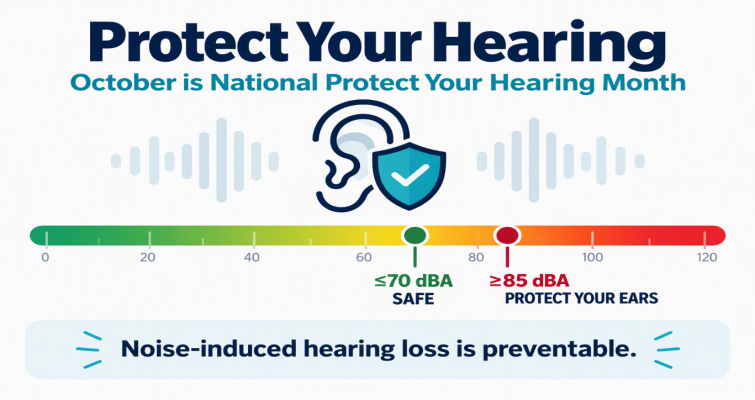
October is National Protect Your Hearing Month, a perfect reminder that our hearing is fragile, valuable, and entirely worth protecting. Noise-induced hearing loss (NIHL) is incredibly common, yet completely preventable by following the 85-Decibel Rule:
Any sound at or below 70 decibels (dBA) is safe for your ears. However, repeated or prolonged exposure to sounds at or above 85 dBA can cause permanent, irreversible damage.
To put that into perspective, normal conversation sits at a comfortable 60 dBA. Everyday sounds like heavy traffic, lawnmowers, power tools, and loud concerts routinely cross into the danger zone above 85 dBA. Over time, this intense vibration wears down the tiny hair cells in your inner ear, leading to hearing loss or chronic tinnitus (ringing in the ears).
Occupational Noise-Induced Hearing Loss
Approximately 22 million to 27 million U.S. workers are exposed to hazardous noise levels at work each year and remains a one of the most common occupational diseases and a leading Occupational Illness. NIHL is the most frequently recorded occupational illness in manufacturing. It is estimated that more than 50% of US workers exposed to noise do not wear adequate hearing protection resulting in about 17,000 new, OSHA-recordable hearing loss cases annually. Overall, occupational hearing loss accounts for approximately 25% of all adult cases.
High-Risk Industries
Manufacturing reports the highest total number of occupational hearing loss cases.
Agriculture, Forestry, and Fishing features some of the highest prevalence rates of NIHL (up to 45.7%) due to heavy machinery, tractors, and livestock noise.
Construction, mining, utilities, transportation, and the military rank high due to long exposure to loud vehicles, machinery, power tools, artillery and explosives.
3 Simple Ways to Protect Your Ears
You don’t have to live in total silence to keep your ears safe. Incorporate these three simple habits into your daily routine:
Know which noises can cause damage.
Wear earplugs or other protective devices when involved in a loud activity; employers must supply activity-specific earplugs and earmuffs.
If you can’t reduce the noise or protect yourself from it, move away from it.
Be alert to hazardous noises in the environment and make colleagues aware of the hazards of noise.
OSHA requires employers to provide free audiometric testing (for hearing loss) for any employee whose 8-hour noise exposure equals or exceeds an action level of 85 decibels (dBA) time-weighted average (TWA).
Your hearing connects you to the people and the world around you. This October, take control of your auditory health and make hearing protection a habit!
Novisal’s Safety professionals can perform noise-level monitoring and written Hearing Protection Plans.