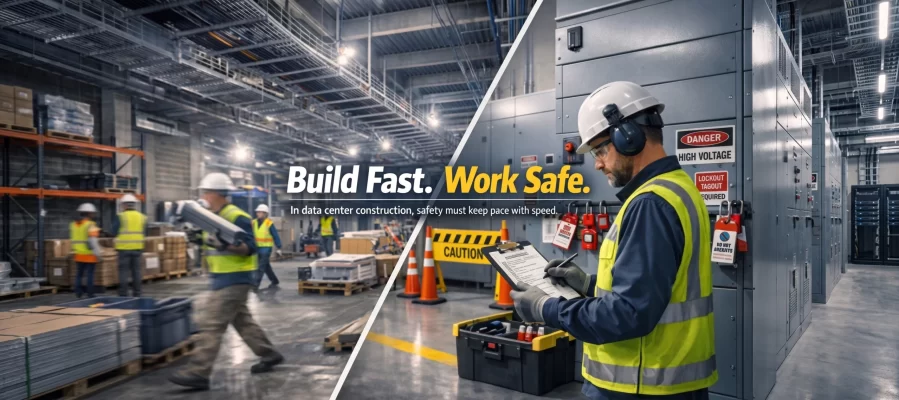
While data centers have been the backbone of modern digital life for the past 20 years, supporting everything from cloud storage and streaming platforms to artificial intelligence and financial transactions, demand for more storage has grown and construction schedules has accelerated—and with that speed comes a higher level of safety risk. Unlike traditional commercial projects, data center construction combines high-voltage electrical systems, heavy equipment, live operational environments, tight coordination among trades, and strict uptime expectations.
The result is a work environment where one missed step can affect worker safety, project timelines, and mission-critical operations. Managing these risks requires more than standard construction oversight; it demands proactive planning, disciplined communication, and a safety culture that keeps pace with the complexity of the build.
Why Data Center Construction Is Uniquely Risky
Data centers are not simple warehouses filled with servers. They are sophisticated technical facilities that depend on continuous power, cooling, fire protection, access control, and network reliability. During construction, and particularly during expansion, crews may work near energized equipment, sensitive infrastructure, and other trades operating in the same space. That overlap creates a narrow margin for error, especially during commissioning, electrical tie-ins, and work inside live environments.
Top Safety Risks on Data Center Projects
- Electrical hazards and arc flash exposure: High-voltage switchgear, temporary power, UPS systems, and energized commissioning work can expose workers to shock, burns, or arc flash incidents.
- Live or partially operational environments: Crews may work near active systems where mistakes can affect worker safety, equipment reliability, and facility uptime.
- Fire risks: Hot work, temporary power, lithium-ion batteries, fuel systems, and combustible materials require strict controls and consistent housekeeping.
- Heavy equipment and material handling: Large generators, chillers, switchgear, cable reels, and prefabricated components create lifting, rigging, struck-by, and pinch-point hazards.
- Trade stacking and schedule compression: Multiple trades working in the same area under tight deadlines can increase congestion, miscommunication, and shortcuts.
- Dust, debris, and contamination: Construction dust and debris can create slipping and tripping hazards, affect indoor air quality, and threaten sensitive technical equipment.
- Fatigue and long work hours: Accelerated schedules, night work, and extended shifts can reduce focus and increase the likelihood of mistakes.
How Teams Can Reduce Risk
Reducing risk starts before workers step onto the site. Project leaders should build safety into planning, scheduling, procurement, and subcontractor coordination. Job hazard analyses should be updated as phases change, especially when systems move from construction power to energized operations. Daily coordination meetings, clear work zones, and strong permit systems help prevent overlapping tasks from creating hidden hazards.
Electrical safety deserves special attention. Lockout/tagout procedures, arc flash assessments, qualified-person requirements, and equipment-specific inspections should be treated as active controls—not paperwork. During commissioning, teams should pause and revalidate assumptions because the site’s risk profile changes once equipment becomes energized.
Fire prevention is also critical. Hot work permits, housekeeping, battery storage controls, temporary power inspections, and compliance with fire-safety planning standards can reduce the chance of ignition. Dust and debris controls, vibration monitoring, and secure access procedures help protect both workers and sensitive equipment in live environments.
Building Safety into the Schedule
The biggest mistake on fast-paced data center projects is treating safety as separate from production. When schedules compress, crews may be tempted to work around controls, stack trades too tightly, or rush energization milestones. A safer approach is to make safety part of the schedule itself. That means planning time for inspections, shutdowns, commissioning reviews, access coordination, and corrective actions.
Safety leadership should also be visible. Supervisors, general contractors, subcontractors, and facility operators need shared expectations and open communication. Workers should feel empowered to stop work when conditions change, protections are missing, or the task no longer matches the approved plan.
Conclusion: Speed Cannot Outrun Safety
The data center boom is reshaping construction, but speed should never come at the expense of safety. These projects demand disciplined planning, strong electrical controls, careful trade coordination, and constant attention to changing site conditions. When safety is integrated into every phase from preconstruction through commissioning teams can protect workers, preserve uptime, and deliver the infrastructure that powers the digital world.