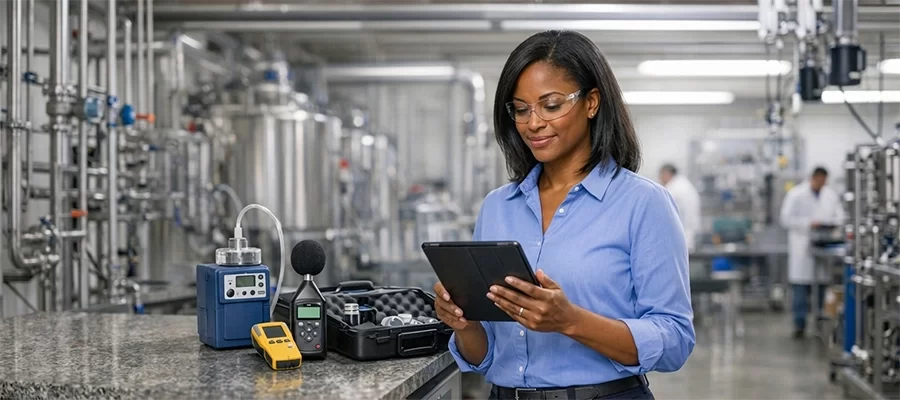
Industrial hygiene services help organizations identify workplace hazards, evaluate employee exposure risks, meet OSHA compliance expectations, and build safer EHS programs.
What Is Industrial Hygiene and Why Is It Important?
Industrial hygiene is a core part of any environmental, health, and safety (EHS) program. It helps organizations anticipate, recognize, evaluate, and control workplace hazards that could affect employee health, safety, or well-being. For companies looking to strengthen OSHA compliance and reduce exposure risk, industrial hygiene services provide a structured path from hazard identification to practical controls.
The Occupational Safety and Health Administration (OSHA) defines industrial hygiene as the science and art devoted to anticipating, recognizing, evaluating, and controlling environmental factors or stressors that arise in or from the workplace and may cause sickness, impaired health and well-being, or significant discomfort among workers or community members. These workplace environmental stressors can be put into three categories; chemical hazards, physical hazards and biological hazards. Chemicals used in production or laboratories, noise, vibration, radiation, mold, asbestos, heat and cold, vectors, hazardous waste are some examples.
How Workplace Exposure Assessment Reduces Risk
Industrial hygiene is not simply a matter of confirming that safety programs exist. A workplace exposure assessment helps identify risks that may not be obvious during routine operations, then guides actions to reduce or eliminate those risks before they lead to injury, illness, regulatory findings, or costly operational disruption.
A strong industrial hygiene program requires vigilance, technical expertise, and accurate exposure assessment. Monitoring can help determine whether employees are being exposed to harmful levels of a hazard. Those findings help EHS leaders design practical controls, select appropriate protective equipment, and improve training.
These assessments can uncover hazards that managers and employees may not recognize day to day. Some risks only become visible over time, which is why proactive evaluation is essential. Organizations have a responsibility to ensure employees are not exposed to preventable risks over the course of their careers. Once risks are identified, organizations can use industrial hygiene services and controls to protect workers, improve EHS program performance, and support compliance.
These may include:
- Industrial Hygiene exposure monitoring
- Personal protective equipment (PPE) assessments
- Respiratory Protection assessments including respirator fit testing
- Job Hazard Analysis
- Ventilation assessments
- Health and safety program design, implementation, and performance measurement
- Radiation, electrical, biological, and hazardous material safety planning
- Chemical hygiene and hazard communication programs
- Indoor air quality assessments
- Preparation for unique, complex, or high-hazard operations
- Proper and thorough employee training
Is Industrial Hygiene Required for OSHA Compliance?
OSHA may not directly require an employer to conduct specific industrial hygiene assessments. However, if an illness, injury, or serious incident occurs, OSHA may evaluate what steps the employer took to identify and mitigate workplace hazards. Many hazards are industry-specific and well known, but others may be unique to a particular worksite or operation. For that reason, employers should develop programs tailored to their own workplaces rather than relying only on what is typically considered hazardous.
For example, chemical exposure monitoring is one of the most closely scrutinized areas of industrial hygiene. Laboratories, manufacturing sites, research facilities, and other workplaces may use large chemical inventories for many different processes. OSHA sets permissible exposure limits for hundreds of chemicals, and employees must not be exposed above those limits.
Additional best-practice exposure guidance is available from organizations such as the American Conference of Governmental Industrial Hygienists (ACGIH) and the National Institute for Occupational Safety and Health (NIOSH). Because there is no single monitoring standard that applies to every chemical in every scenario, organizations often need site-specific industrial hygiene evaluation to determine appropriate respiratory protection, splash protection, ventilation, and other controls.
Industries That Need Industrial Hygiene Programs
Every industry can benefit from industrial hygiene assessments and programs. The specific hazards and controls will vary by facility, operation, and industry, but the goal is the same: protect people while maintaining compliance and operational continuity.
Industrial hygiene is especially important in settings such as:
- Healthcare: Operating rooms, laboratories, and morgues
- Research and Development: Laboratories with diverse materials, experiments, and workflows
- Chemical Processing (e.g.: Food, Pharma, Biotech, Flavor & Fragrance, and Petrochemical) Facilities with large or complex chemical inventories and operations involving active ingredients and potent compounds
- Heavy industry: Workplaces with noise, silica, coal, heavy metals, or other high-exposure concerns
- Manufacturing: Environments with complex equipment and materials including robotics
In practical terms, industrial hygiene supports four critical compliance activities:
- Assessing workplace hazards
- Identifying potential exposure risks
- Understanding the likely severity of those risks
- Selecting relevant and appropriate PPE or other controls
A proactive industrial hygiene program helps identify risks early, protect employees, support OSHA compliance, and strengthen overall safety performance.