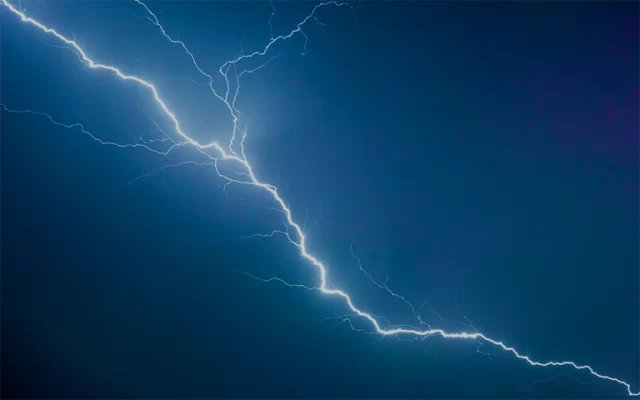
Why lightning is a worksite hazard—even when it’s not raining
If your job takes you outdoors—even part of the day—lightning is a real workplace hazard. Lightning is powerful, fast, and unpredictable. Storms can form quickly, strike miles away from rainfall, and catch people mid-task. In the U.S., cloud-to-ground lightning happens millions of times each year, and hundreds of people are struck annually—some fatally, many with lasting injuries.
Outdoor crews are especially exposed in open areas, on rooftops and scaffolding, near tall equipment, or around conductive materials like metal, water, wet surfaces, wiring and even wooden objects. If you supervise outdoor work, treat lightning like any other serious hazard: plan for it, monitor for it, and stop working early.
Lightening Safety Basics
Lightning can strike outside the heaviest rainfall and even miles away from the storm core. Many injuries happen because people wait too long to get to shelter or go back outside too soon.
The goal is simple: recognize the warning signs early and move everyone to a safe location fast.
- Plan tasks so you can stop quickly. Don’t start a work task that you can’t pause safely when a storm approaches.
- Monitor conditions continuously. Watch the sky and keep an eye on reliable forecasts and alerts.
- Move early. If thunder is audible or lightning is seen, stop outdoor work and get to shelter immediately.
- Wait it out. Don’t resume outdoor work until 30 minutes after the last sound of thunder.
Every thunderstorm contains lightning, and there is no safe place outdoors when storms are in the area. The rule everyone should remember: “When thunder roars, go indoors”. If you can hear thunder—even a distant rumble—seek “safe shelter” immediately, such as a fully enclosed, substantial building with wiring and plumbing or a hard-topped metal vehicle with windows up (if a safe building isn’t available).
Supervisors and Managers should build weather into the plan: adjust work start times, swap tasks, or reschedule so crews aren’t exposed when storms are likely. Check official forecasts and any site-specific alerting tools in use. While work is underway, keep monitoring—darkening clouds, rising winds, and distant thunder are all signals to prepare to stop.
Lorem ipsum dolor sit amet, consectetur adipiscing elit. Ut elit tellus, luctus nec ullamcorper mattis, pulvinar dapibus leo.
Build a lightning plan before the season starts
Lightning safety works best when it’s planned—not debated in the moment. Employers and supervisors should set clear stop-work rules, ensure workers can reach safe shelter quickly, and make sure everyone knows who can call the work stoppage, and how the all-clear will be given.
Make it explicit: if thunder is heard, anyone can raise the alarm—and crews should not be pressured to “finish the last few minutes.” Use a simple headcount or check-in method so you know everyone made it to shelter. Post the protocol where crews gather and train everyone on it before lightning season. Practice how to stop work, account for all workers, and move to shelter quickly.
Lightning detection apps or services
Lightning detection and alerting tools can help you monitor storm activity and decide when to pause work. The important limitation: no system can guarantee prediction of the first strike. Treat alerts as an aid—not permission to stay outside if thunder is already audible or storm conditions are developing overhead. For advance notice, keep an eye on forecasts and radar trends so you can adjust plans early and avoid rushed evacuations.
If you’re caught outside
There’s no truly safe place outdoors during a thunderstorm. If you can’t reach a safe building or hard-topped vehicle immediately, these steps can reduce (not eliminate) the risk while you move to safety.
- Avoid being the tallest object in the area.
- Stay away from isolated tall trees, hilltops, utility poles, towers, cranes, large equipment, ladders, scaffolding, and rooftops.
- Avoid open fields. Never lie flat on the ground.
- Move toward lower terrain (ditches, valleys) if it’s safe to do so—and watch for flooding.
- Get out of and away from water (pools, lakes, rivers) and wet shorelines.
- Stay away from metal objects and pathways that conduct electricity (fences, wiring, plumbing, pipelines, power lines, metal sheds).
- Don’t shelter in small sheds, pavilions, tents, or covered porches—they don’t provide adequate protection.
- If you reach a substantial building, stay away from corded phones, electrical cords/equipment, plumbing fixtures, windows, and doors.
If someone is struck by lightning
Call 911 immediately. If the person is unresponsive, start CPR and use an AED if one is available and you’re trained. Move the person only if needed to get to a safer location. Lightning strike victims do not carry an electrical charge—it is safe to touch and help them.
A quick note on employer responsibility
While OSHA doesn’t have a single “lightning rule,” employers are expected to protect workers from recognized hazards. In practice, that means monitoring conditions, providing access to safe shelter, training crews on stop-work procedures, and pausing elevated or high-conductivity tasks when storms threaten.